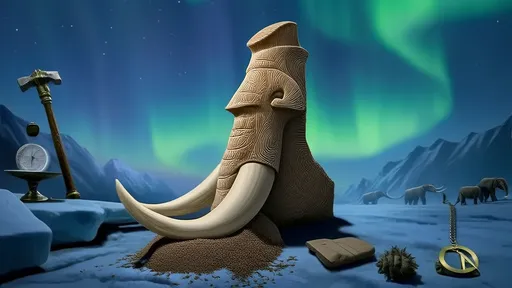
For decades, the frozen remains of woolly mammoths have served as iconic symbols of the Ice Age. But beyond their imposing tusks and shaggy coats, these ancient giants are now yielding groundbreaking insights into Pleistocene ecosystems through an unexpected medium: their tusks. Scientists have developed a revolutionary method to extract and analyze ancient proteins preserved in mammoth ivory, effectively turning these fossils into "climate time capsules" that reveal detailed records of prehistoric vegetation patterns.
The research, published in Nature Ecology & Evolution, demonstrates how isotopic signatures locked within structural tusks proteins can reconstruct the dietary habits of individual mammoths across their lifetimes. Unlike traditional paleoclimate proxies that provide snapshots of environmental conditions, this biomolecular archive offers decade-resolution data spanning 60-80 years - the typical lifespan of a mammoth. "Each tusk contains growth layers similar to tree rings," explains lead researcher Dr. Emilia Varga of the University of Cambridge. "But instead of just showing annual growth patterns, we're reading the biochemical diary of everything the animal ate."
Advanced mass spectrometry techniques enabled the team to identify specific plant biomarkers within collagen and other structural proteins. The relative abundance of carbon-13 isotopes in amino acids like proline and hydroxyproline revealed dramatic shifts between grasses and woody plants during different climate phases. Particularly striking were the abrupt vegetation changes corresponding to known climatic events like the Younger Dryas cold snap around 12,900 years ago, recorded in tusks from Siberia's Yamal Peninsula.
This paleobotanical detective work relies on a fundamental principle of biochemistry: you are what you eat. As mammoths consumed different plant communities, distinctive isotopic fingerprints became incorporated into their growing tusks. The researchers developed calibration models comparing modern elephant diets with their tusk chemistry before applying these relationships to extinct species. "The precision astonished us," notes co-author Professor Lars Jørgensen. "We could track a single individual's transition from browsing shrubs to grazing grasses during a warming period, then back again when temperatures dropped."
Beyond reconstructing paleodiets, the protein analysis provides unprecedented insights into megafauna-vegetation-climate feedback loops. The data suggest mammoths played active roles in maintaining the mammoth steppe ecosystem through nutrient cycling and seed dispersal. Periods of population decline correlate with vegetation shifts toward less nutritious plant communities, potentially accelerating environmental changes. "These aren't just passive climate recorders," emphasizes Dr. Varga. "The mammoths were ecosystem engineers whose disappearance reshaped Arctic landscapes."
The methodology also solves longstanding challenges in Ice Age research. While pollen records offer broad regional vegetation patterns, they lack the temporal resolution and species specificity of the tusk protein data. Similarly, gut contents or coprolites provide single-meal snapshots rather than lifelong dietary histories. "For the first time, we can follow an individual's ecological journey from birth to death," says Professor Jørgensen. "One particularly well-preserved specimen showed clear evidence of nutritional stress in its final years, coinciding with the spread of less palatable vegetation."
Conservation biologists are particularly excited about the technique's implications for understanding climate change impacts on modern ecosystems. By comparing the Pleistocene data with contemporary Arctic vegetation shifts, researchers identified similar patterns of plant community reorganization during rapid warming events. "The past isn't just informative - it's predictive," notes Dr. Varga. "Seeing how ecosystems responded to abrupt climate shifts 15,000 years ago helps us anticipate changes occurring today."
Future applications could extend beyond mammoths. The team is adapting their methods to study other extinct megafauna like woolly rhinos and giant deer. There's also potential to analyze proteins from much older specimens, possibly pushing the technique back millions of years. As museum collections worldwide contain thousands of tusks and teeth, researchers now have access to a vast, untapped archive of paleoecological data waiting to be decoded.
This interdisciplinary approach bridges paleontology, biochemistry, and climate science in unexpected ways. What began as a study of ancient proteins has blossomed into a powerful new tool for understanding ecosystem dynamics during periods of dramatic environmental change. The humble mammoth tusk, once prized for ivory carvings, now delivers its most valuable treasure: a molecular chronicle of our planet's climatic past, written in the language of amino acids and waiting 15,000 years to be read.

By /Aug 18, 2025
By /Aug 18, 2025

By /Aug 18, 2025
By /Aug 18, 2025

By /Aug 18, 2025

By /Aug 18, 2025

By /Aug 18, 2025

By /Aug 18, 2025

By /Aug 18, 2025

By /Aug 18, 2025

By /Aug 18, 2025

By /Aug 18, 2025

By /Aug 18, 2025
By /Aug 18, 2025

By /Aug 18, 2025

By /Aug 18, 2025

By /Aug 18, 2025

By /Aug 18, 2025

By /Aug 18, 2025

By /Aug 18, 2025
